
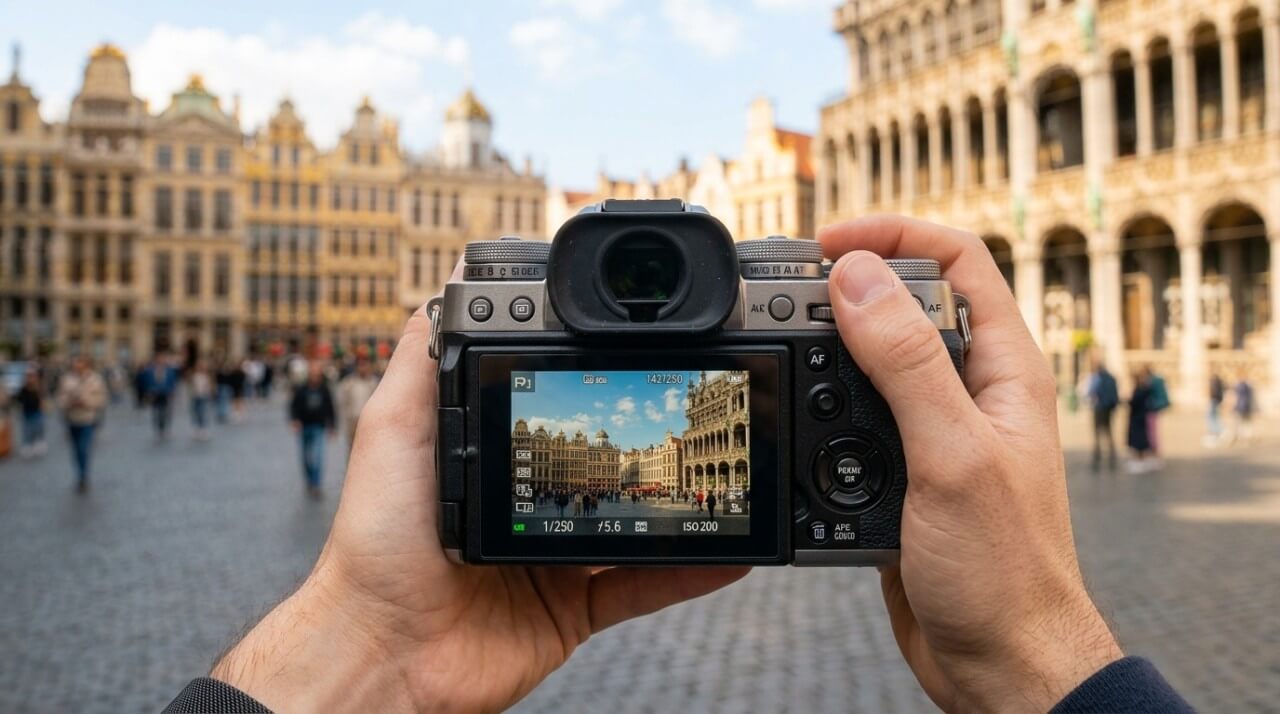
Central Brussels rewards photographers who are willing to walk slowly. Within a few kilometres, medieval lanes give way to gilded guild houses, glass-roofed arcades, Gothic churches, formal gardens and broad viewpoints across the lower city.
A strong photography route starts at Grand-Place, passes through the Galeries Royales Saint-Hubert and the Cathedral of Saints Michael and Gudula, climbs through Mont des Arts, continues to Place Royale and the Sablon, then reaches Place Poelaert before looping back past Manneken-Pis.
Allow around 3 to 4 hours if photography is the priority. The walking itself takes far less time, but Brussels has a habit of making you stop every hundred metres.
The Route at a Glance
| Stop | Best Photographic Subject | Useful Approach |
| Grand-Place | Guild houses, Town Hall, symmetry | Wide angle |
| Galeries Royales Saint-Hubert | Glass roof, repeating arches | Symmetrical compositions |
| Cathedral | Gothic façade, stairs, people | 24 to 50 mm |
| Mont des Arts | Skyline and layered cityscape | Wide or short telephoto |
| Place Royale | Neoclassical architecture | Geometry and street scenes |
| Grand Sablon | Church, cafés, antiques | Documentary photography |
| Place Poelaert | Brussels panorama | Wide landscape framing |
| Manneken-Pis | Crowds and street atmosphere | Environmental shots |
Starting early gives the cleanest architectural photographs. An evening version works well in reverse, with Place Poelaert timed for sunset.
If you want to photograph the city at either end of the day, centrally located rooms near the Bourse make it easy to reach the historic centre without adding a long journey before or after the walk.
1. Start Early at Grand-Place
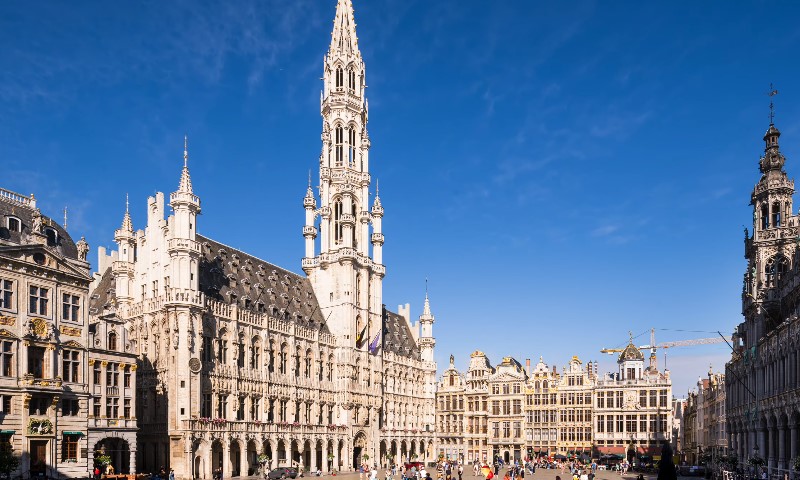
Grand-Place deserves the first light of the day. Later, tour groups, deliveries and people photographing one another quickly fill the square.
The City of Brussels describes Grand-Place as the historic centre of the city, surrounded by guild houses, the Town Hall and Maison du Roi.
The square has held UNESCO World Heritage status since 1998. Much of the architecture visitors see today emerged after the French bombardment of Brussels in 1695, followed by rapid rebuilding at the end of the 17th century.
Photography becomes easier when you stop trying to fit the entire square into every frame. Pick individual façades. Look for carved figures, gold details and windows catching reflections from buildings opposite.
For a wider composition, stand toward a corner rather than directly in the centre. The slight diagonal gives the surrounding façades more depth.
Wet weather can even help. Damp paving reflects the gold ornamentation and lights, giving the square a completely different character.
2. Use the Galeries Royales for Symmetry
Walk northeast from Grand-Place into the Galeries Royales Saint-Hubert.
Opened in 1847, the galleries rank among Europe’s early covered shopping arcades. Architect Jean-Pierre Cluysenaer created a long glazed passage lined with shops, cafés and cultural venues.
Victor Hugo and Alexandre Dumas were among the writers associated with the galleries during the 19th century, according to Visit Brussels.
Photographically, repetition does most of the work. Stand along the central axis and let the arches and glass ceiling lead the eye through the frame.
Then abandon symmetry for a few minutes. Café tables, shop windows and people crossing patches of light produce stronger street photographs than another perfectly centred arcade image.
Rainy days are particularly useful here. The covered gallery offers controlled light while the surrounding streets remain wet and reflective.
3. Photograph the Cathedral From Low on the Square
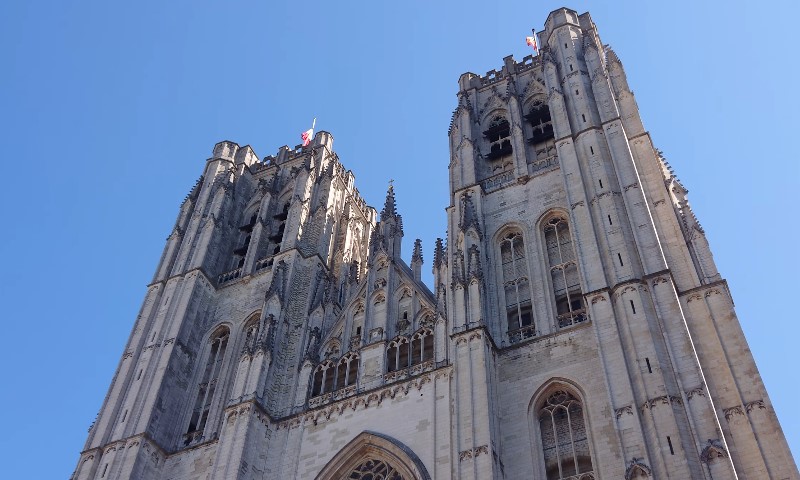
A short walk leads to the Cathedral of Saints Michael and Gudula.
Construction began in 1226, while the western façade dates largely from the 15th century. Its twin towers rise 69 metres, giving the building a striking presence when viewed from the lower edge of the square. The cathedral history provides further detail on its architectural development.
Rather than walking immediately to the entrance, stay near the bottom of the approach. The steps naturally lead toward the façade, while pedestrians supply scale.
A moderate focal length around 35 to 50 mm can also isolate one tower, a section of stonework or the movement on the stairs.
The cathedral marks its 800th anniversary during 2026, with concerts and cultural programming scheduled during the year. Photographers visiting during an event can check the Gudula26 programme beforehand because visitor patterns around the building can change.
4. Climb to Mont des Arts
View this post on Instagram
From the cathedral, head toward Brussels Central Station and continue to Mont des Arts.
The garden connects Brussels’ historic lower city with Place Royale above. Its present form grew from an urban complex developed during the 20th century, while the garden occupying the site was restored in 2001. Visit Brussels has more information about the Mont des Arts garden.
Here, elevation changes the photographs completely.
From the upper steps, the formal garden creates strong foreground geometry while the tower of Brussels Town Hall rises above the rooftops in the distance. Visit Brussels notes that the Town Hall tower reaches 96 metres, making it one of the defining features of the Brussels panorama.
Try both focal extremes. A wide lens captures garden, skyline and sky. A short telephoto compresses the roofs and makes the Town Hall tower appear much closer.
People sitting on the steps also make excellent foreground subjects, particularly in late afternoon.
5. Slow Down Around Place Royale
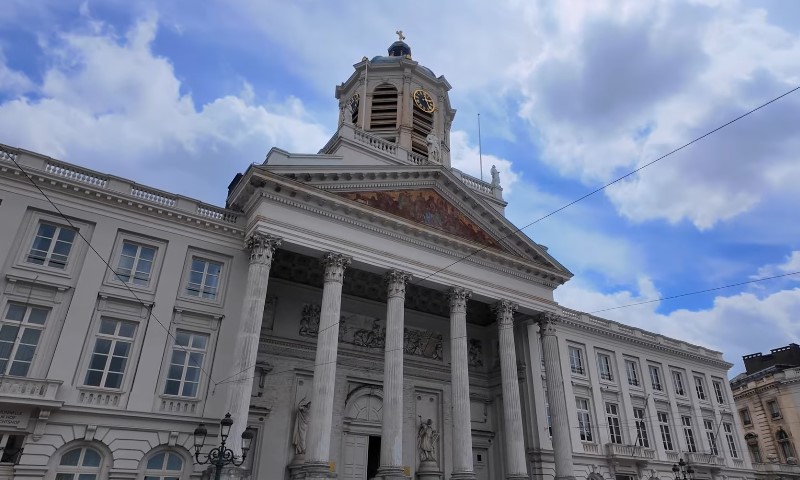
Keep climbing and Brussels changes character again.
Place Royale belongs to the neoclassical Royal Quarter, built around the former Coudenberg Palace area. The surrounding architecture is noticeably more ordered than the irregular medieval streets below. The square forms part of the city’s collection of major Brussels attractions.
Geometry works well here. Look for repeated windows, straight façades, the statue at the centre of the square and people crossing large areas of open pavement.
Nearby museum buildings can also create cleaner architectural photographs than the visually dense historic centre. A cloudy sky suits pale stone especially well because harsh highlights disappear.
6. Let the Sablon Add People to the Route
Follow Rue de la Régence toward Grand Sablon.
Architecture remains strong, but everyday life begins to take over the frame. Cafés spread onto pavements, chocolatiers fill the shopfronts and the Gothic Church of Our Lady of the Sablon rises above the square.
Grand Sablon also hosts its antiques market on Saturdays and Sundays. The market traces its origins to 1960, when local antique dealers began gathering near the church. The current Sablon antiques market remains a useful stop for photographers interested in people, objects and street-level detail.
Weekend photographers therefore get a different subject entirely. Old prints, furniture, collectors and browsing shoppers add layers of human activity.
The neighbouring church rewards closer study too. Its origins are connected with Brussels’ crossbowmen, who built the Gothic structure during the 15th century.
7. Finish the Main Walk at Place Poelaert
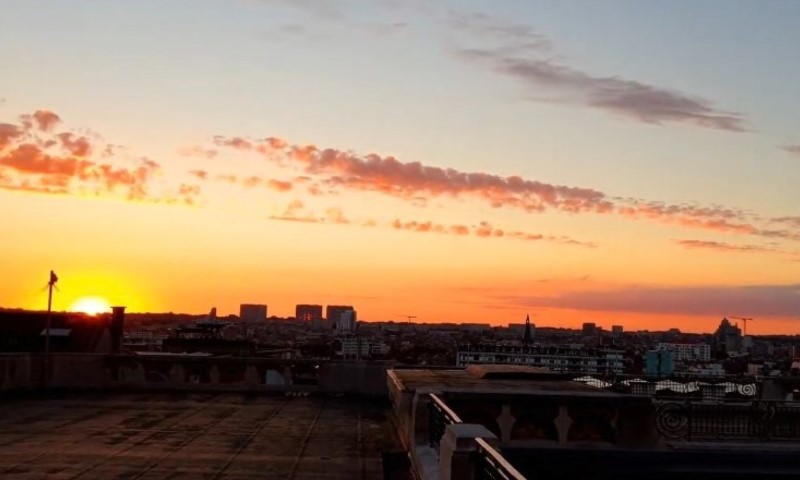
Continue along Rue de la Régence until the enormous Palace of Justice appears.
Beside it, Place Poelaert opens toward one of central Brussels’ broadest panoramas. Visit Brussels recommends the square for views across the lower city and notes that landmarks including the Basilica of Koekelberg and Atomium can be visible on the horizon. Sunset is particularly effective from the Place Poelaert viewpoint.
After several hours photographing detailed façades, the open skyline feels almost extravagant.
Use buildings, railings or people in the foreground rather than pointing the camera directly at the horizon. Layers give the city scale.
For an evening photography walk, ending here around sunset is the strongest option.
8. Loop Back Past Manneken-Pis
View this post on Instagram
Walk downhill through the older streets toward Grand-Place and make one final stop at Manneken-Pis.
The small bronze figure has become one of Brussels’ best-known symbols, although its origins were practical. The fountain formed part of the city’s drinking-water system from the 15th century. Its wardrobe now contains more than 900 costumes, according to the official Manneken-Pis history.
The statue itself can be difficult to photograph creatively because crowds gather around a very small subject.
Turn the camera around occasionally. Reactions, phones held overhead and people discovering just how tiny the famous statue actually is can tell a better story about Brussels than another tight photograph of the bronze figure.
A Route That Works Because Brussels Keeps Changing
Central Brussels fits several distinct visual personalities into a remarkably compact area. Grand-Place offers architectural spectacle. Saint-Hubert provides symmetry. The cathedral supplies Gothic scale, Mont des Arts opens the skyline, while Sablon brings street life into the frame.
Place Poelaert then pulls the entire city into one final panorama.
A fast walker could cover the route quickly. A photographer should resist the temptation. Leave room for reflections, unexpected light, passing bicycles, café scenes and the narrow side street that suddenly looks better than the landmark you came to photograph.
Brussels rewards the extra ten minutes.